
Attack from Within

How Disinformation is Sabotaging America

by Barbara McQuade

Publisher: Penguin Random House

UPDATED EDITION: The MSNBC legal analyst explores the impact of disinformation after the 2024 presidential election—and what Americans can do before it’s too late.

“A comprehensive guide to the dynamics of disinformation and a necessary call to theethical commitment to truth that all democracies require.” —Timothy Snyder, author of On Tyranny

Disinformation—the deliberate spreading of lies disguised as truth, whether from opportunists on the far right, misinformed media influencers, or others—is fragmenting America more than ever before, pushing the nation toward extreme views, civil unrest, and violence.

In this bestselling book, now with a new foreword by the author, Barbara McQuade identifies how disinformation is seeping into all facets of our society, causing havoc in our voting systems, schools, hospitals, workplaces, and the Capitol.

McQuade, an MSNBC legal analyst and former federal prosecutor confronts the ways disinformation is being weaponized to polarize voters, degrade our legal structures, and leverage the political influence of manipulators and authoritarians. Now newly updated, Attack from Within shows us how to fight back against misinformed, extremist thinking and work toward preserving America’s hard-won democracy.

Buy

Thoughts on Aliens of Our Creation

Do they work for us, or for themselves?

By: Bruce Rafnel

Publisher: Substack, Authentic Community

Clearly, humans are causing climate change.

But we have more problems than warming the planet. Even if we control the temperature by reducing our CO2 emissions, there are many other ecological problems caused by humans: deforestation, desertification, disruption of water cycles, plastic pollution, insect decline, fishery collapses, and fuel resource depletion. The list goes on and on. “It is no accident that the ruins of the world’s oldest civilizations are mostly in deserts now. It wasn’t desert before that.”

Our human institutions are unwilling (or unable) to address these problems with real solutions. We created these institutions—corporations and governments, most notably—but we seem unable to control them. They have morphed into alien entities that now control us.

The smallest effective human-powered unit is a community, not an individual. However, tight, effective communities have been hobbled. It is time to relearn how to build communities, and then to do the work of taking back our government. At the same time, large organizations can be reformed or broken up, with non-violent actions, to remind them that they exist for humans, not themselves.


Authentic Community feed

4 tips for developing critical thinking skills

By: Steve Pearlman, Ph.D

Publisher: TEDx Talks, TEDxCapeMay

“Critical thinking” increasingly stands as the most sought-after skill that has long been too fleeting to define. Employers rate it as a pinnacle skill, but one of which they see too little, and educators claim to teach it, but over half of Millennials recently failed a simple Mindedge critical thinking test. So, what is critical thinking? Analysis? Information literacy? Thinking outside the box? Informal logic? Problem-solving? Evaluating data? Decision science? What if all of our efforts to define critical thinking as above have been the core problem with teaching it?

What if, instead of using our brains to devise conceptions of critical thinking, we eliminated the noise and revolutionized a way to teach people how to think better by tracing critical thinking back to its core evolutionary survival mechanisms?

What are the basic survival skills for all organisms?

  1. Perceive their environment
  2. Sense danger vs. reward
  3. Decide between danger and reward
  4. Act on the decision

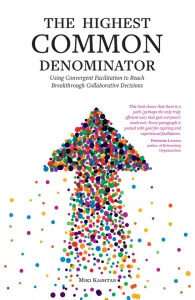
The Highest Common Denominator

Using Convergent Facilitation to Reach Breakthrough Collaborative Decisions

by Miki Kashtan

Miki introduces a novel decision-making process called Convergent Facilitation that builds trust from the beginning, surfaces concerns and addresses them, and turns conflicts into creative dilemmas that groups feel energized to solve together. This highly effective process has been used successfully around the world to resolve problems and teach people how to collaborate without sacrificing productivity.

Continue reading The Highest Common Denominator

Convergence Learning Lab for government

Recommended by: Bob B. – “Convergence Center for Policy Resolution, provides services and training for those wishing to transform conflict into collaboration.”

In a country marred by deep conflict, city, county, and state officials face mounting pressure to engage diverse stakeholders in resolving contentious and complex public policy issues. The Convergence Learning Lab’s training and consultation services empower leaders with the necessary skills to bridge these divides resulting in more productive public meetings, more constructive community engagement, and, ultimately, better outcomes for constituents.

Lab services are built on our unique, evidence-based collaborative problem-solving methodology which has been used to successfully address seemingly intractable political, social, organizational, and community-based issues.

Our process has proven consistently successful at producing the kinds of results that drive impact.

Convergence’s success offers a beacon of hope for the majorities of Americans frustrated by divisiveness that change is not only possible, but that we have the tools and the knowledge to bridge even the starkest divides with consistency. In addition, our success highlights the rich set of tools, practices, and resources that others can use to achieve similar successes.

  1. We select issues that are ripe and amenable for Convergence and stakeholder-participants to collaboratively “unstick,” and frame a discussion-onramp to the issue that is both crucial and disarming.
  2. We convene diverse tables of participant leaders and doers, many of whom oppose each other so stridently they never thought they could talk to one another.
  3. We facilitate participants to build trust, find common ground. Participants abide by a set of ground rules including honoring all points of view, respecting the confidentiality of the conversation, and listening carefully when others speak.
  4. We generate consensus solutions collaboratively among dialogue participants through establishing guiding principles that create a framework for the policy discussions to come. Once stakeholders are aligned on a bigger vision, they are ready to work together to produce new ideas and solutions.
  5. We deliver societal impact and on-the-ground implementation of the solutions. By design, a Convergence project strives to engage stakeholders to take action on their ideas after the dialogue stage is completed, or in some instances, even while the dialogue is going on. Convergence itself does not formally endorse stakeholders’ proposals – it remains policy neutral – but often plays a stewarding role to maximize the impact stakeholders can achieve.


National Coalition For Dialogue & Deliberation

Bringing people together across divides to tackle today’s toughest challenges

Recommended by: Bob B. – “(NCDD), a nonprofit membership organization that maintains a database of collaborative organizations around the world.”

What We’re All About

The National Coalition for Dialogue & Deliberation (NCDD) is a network of innovators who bring people together across divides to discuss, decide, and take action together effectively on today’s toughest issues. NCDD serves as a gathering place, a resource center, a news source, and a facilitative leader for this vital community of practice.

Dialogue and deliberation are innovative processes that help people come together across differences to tackle our most challenging problems. In a time when we are increasingly told how divided we are in so many ways in our nation and in our world, teaching, spreading, and supporting the skills of dialogue and deliberation are vital.

The NCDD website is a clearinghouse for literally thousands of resources and best practices, and our highly participatory national and regional conferences have brought together more nearly 3,000 practitioners, community leaders, public administrators, researchers, activists, teachers and students since 2002. We keep in touch monthly with 28,000 people involved in public engagement and conflict resolution work.

Above all, NCDD provides opportunities for members of the broadly-defined dialogue and deliberation (“D&D”) community to share knowledge, inspire one another, build collaborative relationships, and have a greater collective impact.

Below you’ll find our contact info, mission, details about our membership, and more. You can also read the full story of NCDD’s beginnings and learn about the NCDD team. And, of course, if this resonates with you, please consider becoming a member or making a donation to NCDD!

Why did the Coalition form?

NCDD exists to support the growing “dialogue and deliberation community” — a broadly-defined community of practice involving practitioners, scholars, activists, public officials, nonprofit leaders, process geeks, students, and others who engage and mobilize people to come together and strengthen understanding of each other and issues in ways that supports community-building and collaborative problem-solving.NCDD was formed in 2002 in response to a clear need for an infrastructure for learning and collaboration among those who approach D&D from a variety of disciplines, including public policy, social work, communication, education, social justice, social activism, and organizational development. The Coalition was a result of the first National Conference on Dialogue & Deliberation, held near Washington, DC in October 2002.

NCDD is an educational organization and a Community of Practice. Communities of practice are formed by people who engage in a process of collective learning in a shared domain or topic area.  In other words, communities of practice are groups of people who share a concern or a passion for something they do and learn how to do it better as they interact regularly.

Our members make up the core of our community of practice. As of January 2021, the Coalition’s membership has grown to include 700 organizations and individuals. Our website visitors, social media group members, conference attendees, and over

28,000 newsletter subscribers are also part of this ever-growing community of practice.
https://www.ncdd.org/